


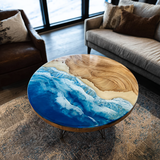





Does epoxy table resin yellow over time? It's a question every custom table buyer asks—and for good reason.
Why Does Epoxy Resin Turn Yellow?
Yellowing isn’t a manufacturing defect—it’s a chemical reality. Here’s what’s happening at the molecular level:
- UV breaks polymer chains, creating chromophores that reflect yellow/amber.
- Oxidation from heat and oxygen forms carbonyl groups, adding yellowing.
- Aromatic amine hardeners react with UV, darkening pours to honey tones in months.
- Heat doubles yellowing by accelerating both photodegradation and thermal degradation.

Does Every Epoxy Table Yellow? (The Variables)
Not all resins are created equal. Whether your table turns yellow depends on several key factors:
- Resin: Standard = no UV protection; UV-stable = longer clarity.
- Pigment: Dark/opaque hides yellowing; clear/light needs UV protection.
- Placement: No windows = safe; near windows = yellow in months without protection.
- Thickness: Thin pours cure better, yellow slower; thick pours trap solvents, darken.

How to Choose and Protect Your Resin Table (Practical Tips)
To get the longest life out of your piece, follow these guidelines:
- Use UV-stable resin (labeled non-yellowing or HALS-enhanced); avoid generic craft resins.
- Apply UV-blocking topcoat like marine spar or aliphatic urethane; recoat every 2–3 years.
- Avoid direct afternoon sun; use low-E glass or UV-filtering curtains near windows.
- Apply UV-protective furniture wax quarterly to extend protection and enhance sheen.

Don't let yellowing fears hold you back. Choose a UV‑stabilized epoxy, add a protective topcoat, and keep your table out of harsh sunlight. With the right approach, your table will stay beautiful for years.
Ready to build yours? Let's get started.